A Tale of Two Banks
Food banks and commercial banks seem to have nothing in common – except they’re both booming.

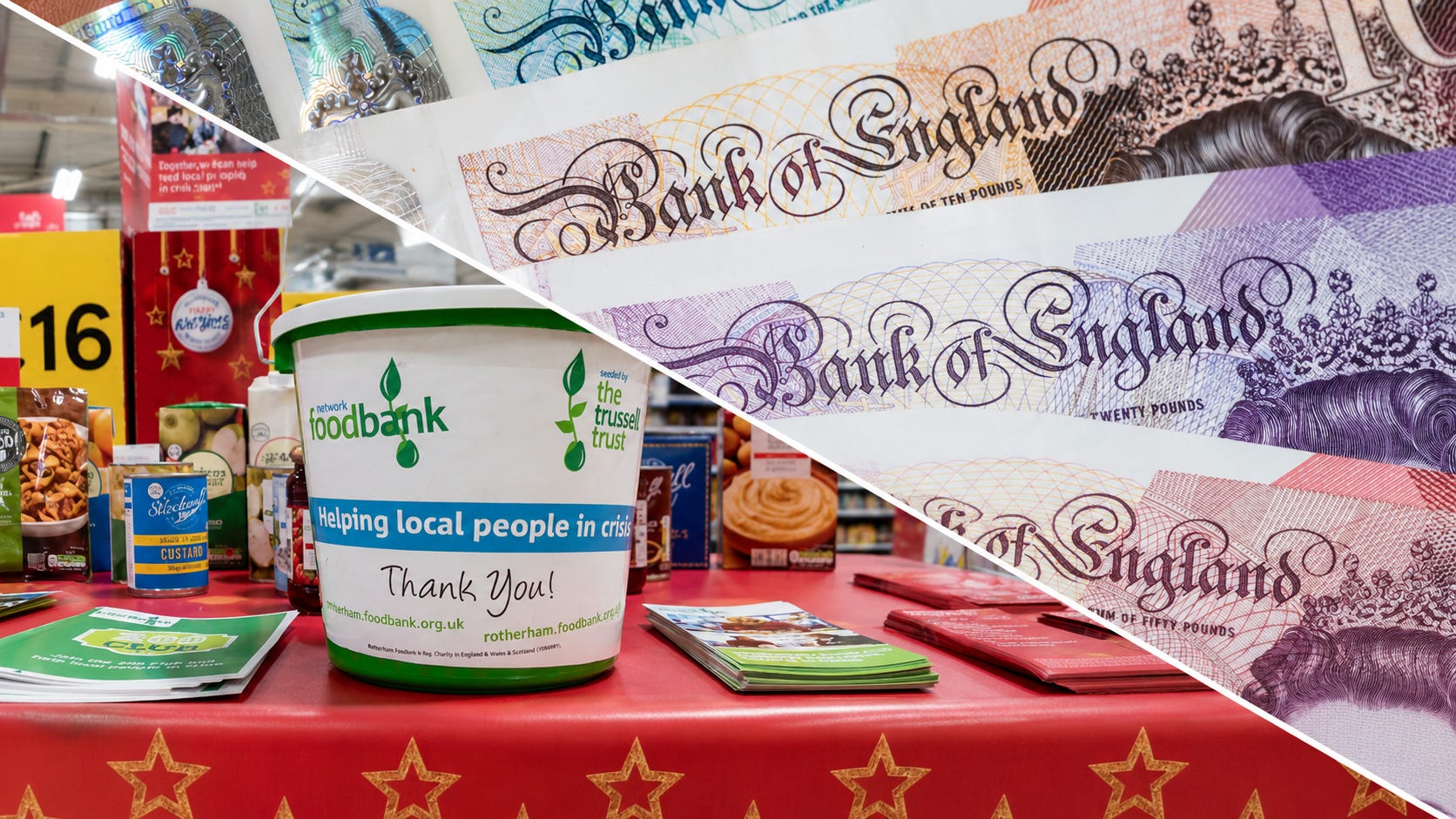
One hands out modest parcels of donated pasta, cereal and tins of soup to people who cannot afford to eat. The other receives enormous sums of risk-free public money as interest payments from the Bank of England.
One is called charity. The other is called monetary policy.
One depends on public kindness. The other depends on public design.
Yet, for all their differences, they are intimately connected.
The new normal
Food banks are now a normalised part of the UK landscape. They are opened by public figures, praised by politicians, supported by supermarkets and photographed as proof of community spirit. The volunteers deserve respect. The donors deserve thanks.
But the situation is shameful.
A food bank is not a civic achievement in the way a school, library or health centre is a civic achievement. It is an economic warning light, flashing red with klaxon blaring.
It is signalling that wages, benefits, rents, debt collection and public administration have failed to do one of the most basic things a civilised country should do – keep people fed.
In 2024/25, Trussell food banks distributed 2.9 million emergency food parcels, including more than a million for children. They operated from 1,711 locations, alongside at least 1,172 independent food banks. Even before wider food-aid provision is counted, the UK has close to 3,000 food-bank locations.
Yet the UK is one of the richest countries in the world. It is much richer than it was in the 1960s and 1970s, when mass food-bank use was not a normal feature of British life.
So why is it normal now?
And why can the UK state organise automatic public payments to commercial banks, but not automatic protection against hunger?
The money flowing to banks
Automatic public payments to commercial banks – what does that mean?
The basic story is simple. Commercial banks hold money – ‘reserves’– at the Bank of England, which pays interest on those reserves to set a ‘floor’ for interest rates in the financial system.
Initially, this was no big deal. Total reserves were much smaller than they are now and interest rates were low.
But after the financial crisis of 2007-08, the Bank started to create a huge amount of new reserves to buy back, from the market, large quantities of government bonds previously issued by the Treasury – a process called quantitative easing (QE). During Covid, the Bank created still more reserves through QE, while the Treasury funded emergency schemes such as furlough.
In plain English, one part of the state (the Treasury) issued the bonds and another part of the state (the Bank) bought many of them.
The Bank’s bond purchases were put into a separate vehicle, the Asset Purchase Facility (APF), owned by the Bank but backed by the Treasury. The logic was that the Bank would make the monetary-policy decisions, while the Treasury would carry the public-money risk. Any profits would flow to the Treasury – but any losses would be covered by the Treasury. That may have looked prudent in 2009. But it means that when the scheme turns loss-making, the bill lands visibly in the public finances.
Other countries have handled the costs and accounting differently. So this is not just ‘how central banking works’. It is a UK design choice.
The indemnity
The Treasury’s promise to stand behind the Bank’s QE scheme is called the indemnity.
While interest rates were close to zero, the APF generated cash. It was receiving interest on the bonds it held, while paying very little interest on the reserves created to buy them.
Then, in 2012, George Osborne arranged for the APF’s surplus cash to be transferred regularly to the Treasury, rather than left to accumulate inside the APF. That helped the government’s finances while rates were low. But the risk was there from the beginning, and by 2012 the warning was explicit – when interest rates rose, the flow could reverse.
Which is exactly what happened.
Inflation rose sharply after Covid and the energy shock. Bank Rate rose with it. The AFP began paying much more interest on the huge stock of reserves than it was earning on many of the older, lower-yielding bonds it held.
So the QE scheme moved from profit to loss – and because of the indemnity, the bill landed with the Treasury.
Bottom line – in the two years to February 2025, the Treasury transferred more than £80 billion to the Bank of England to cover QE losses.
But who really pays?
And that money lands inside the public finances — the same public finances ministers invoke when they say there is not enough money for councils, schools, hospitals, benefits or hunger prevention.
A serious first-stage plan to end routine food-bank dependence might cost around £10–15 billion a year. A full guarantee may cost more. But the order of magnitude is clear.
So Parliament should ask a simple question – why is £40 billion-plus a year for Bank of England losses treated as a technical necessity, while £10–15 billion to begin ending routine food-bank dependence is treated as fiscal radicalism?
The double standard is impossible to ignore.
When banks receive risk-free public interest payments, it is ‘essential to monetary transmission’. When families need enough to eat, it is ‘welfare spending’ or ‘handouts’. When markets need reassurance, the state acts. When children need breakfast, the state asks whether it can afford to.
That is not prudence. It is a policy choice.
The Bank’s defence
The Bank of England says that paying interest on reserves helps it control interest rates and stabilise the economy. Fine. But can the Bank still control interest rates without handing unnecessary public gains to commercial banks?
Other central banks show that choices exist. The US Federal Reserve also pays interest on reserves, but when it makes losses it records them against future profits rather than sending a cash bill to the US Treasury. The European Central Bank has moved to paying 0% on minimum reserves.
So the UK’s current system is not a law of nature. It is architecture — and if that architecture creates large unearned gains for commercial banks while food banks are normalised, it must be re-examined and redesigned or taxed.
The working poor
The asymmetry is grotesque, especially as food banks are not just for people outside work. Trussell’s evidence shows that three in ten people referred to food banks in 2024 were in working households, up from 24% in 2022.
In other words, some people work and still cannot afford to eat. Some have wages topped up by Universal Credit. Some have insecure hours. Some lose pay when they are sick. Some face rent rises, energy debt, benefit delays, deductions or sudden household shocks. One unexpected expense and the cupboard is empty.
A political class that tells people to work and then relies on charity to feed a significant portion of them has lost the right to lecture anyone about responsibility.
And food banks did not appear by accident. They are the result of political choices made over decades – weaker bargaining power at work, insecure jobs, high rents, benefit cuts, sanctions, caps, deductions, local-government cuts and a welfare system that catches people only after they have fallen.
Food banks are a direct result of modern UK economic dogma – a charitable patch placed over an economy that lets too many people fall below subsistence and then praises volunteers for catching them.
A Food Security Guarantee
So here is the proposal – create a Food Security Guarantee.
The principle is simple – no household in the UK should be pushed below the level needed to buy food and basic essentials. No referrals or pracels – money in the household’s account before hunger arrives. Which means three things immediately.
Stop Universal Credit deductions, advance repayments and government debt recovery from pushing people below the essentials floor.
Create cash-first crisis support through local authorities, so benefit delays, rent shocks, illness, job loss or sudden loss of hours trigger cash – not a food-bank voucher.
Raise the incomes of households most at risk – disabled people, carers, families with children, renters, people in insecure work and people whose wages are topped up by Universal Credit.
And how to fund this? Start by recapturing part of the public money already flowing into the banking system – we could call it the ‘Bank-to-Food-Bank Dividend’.
Redesign the system so the Bank of England can still control interest rates but without handing huge sums of unearned public money to commercial banks. And use the savings to fund food security.
If the Bank says full reserve interest is essential, demand proof. If the Treasury says a windfall tax would be dangerous, demand the evidence. If ministers say the money cannot be found, demand that they explain why it can be found for the banking system but not for hungry families.
Time for new choices
This is not about arguing that public money has no limits. It is about asking why the limits always appear when poor people need security and so often disappear when the financial system needs support.
The public understands unfairness. A country able to find free money for banks should be able to feed children. If work no longer keeps families out of food banks, something fundamental has broken.
You pays your money and you takes your choice.
So why are ministers, the Treasury and Parliament choosing this?
Excellent! Great explanation of the stupid system the BoE and Treasury have.
And it’s brilliant you highlight the inequality of the poor against the rich banks.
Your right. This doesn’t have to happen! The political ineptitude that Denys the majority of its rightful path for money, spending and earning is as you say grotesque.
The system is political and it’s failing. Because the people charged to run it are devoid of the ability to rewrite it.
The truth is, money has to be managed. And we can’t allow money to be held or rather withheld from the daily productive economy. Because it’s that non existent cash flow by Spending that’s missing in action!
It’s not that we haven’t enough money. You highlight where a small amount is waisted. It’s because not enough of that money is in our daily productive economy!
Money has to be used for us to fairly exchange work. You’re work for mine. It has a geo sided implied contract.
When you get payment rewarded by money for work, you are contracted to swap the money back again for the work of others. And that’s not happening! Only part of our money is doing that swap. Most is being held outside our daily economy by the Banks pension funds, wealth funds and tax havens. So much money isn’t in our total daily spending that we have the inequality you see. And we are forced to beg for it or worse borrow it where we have to pay full capital plus interest and in the case if investments future earnings!
This cannot be sustained. And governments see it but do sod all about it!
Perceived greed and the need to save to avoid borrowing us the answer if choice. But even that’s still not SPENDING money! It’s still hoarding money. No.
What we need is money to be perpetually flowing unhindered and SPENT back in a time scale that befits the need to pay. Monthly.
We already spend all our money now. Thats if we are poor or good earners. We spend to afford better. But we still spend. This creates a true cash flow. Whereas nit spending and trashing in banks stifles cash flow. Stops cash flow and makes us all devoid of its use. Even our tax system doesn’t tax our vast banking unused unspent money! So it’s not in our economy but is it taxed. Wrong! Very wrong.
That’s why we are short of money! It’s not because there isn’t enough! No , it’s simply out there but inactive and not being spent. And moreover it’s now being loaned by those who have too much money that they don’t spend it.
It’s being borrowed by us who haven’t got it. And now by our governments who think like a household budget and choose to borrow it back from the very people withholding it in the first place! The rich.
We shouldn’t do more than reinstate exchange control regulations. Swap a new digital currency for all old money and put a spend by date in that money?make it all move perpetually and autonomously. All that increased flow of spending will be a tsunami of spending s large our benefits can rise and wages rise and tax take rise. Win win win.